What’s the Tea with Vitamin E?
Vitamin E is a collective term for eight different closely related compounds of tocopherols and tocotrienols. Alpha-tocopherol (a-TOH) is the most bioavailable and preferred form for uptake by the liver.
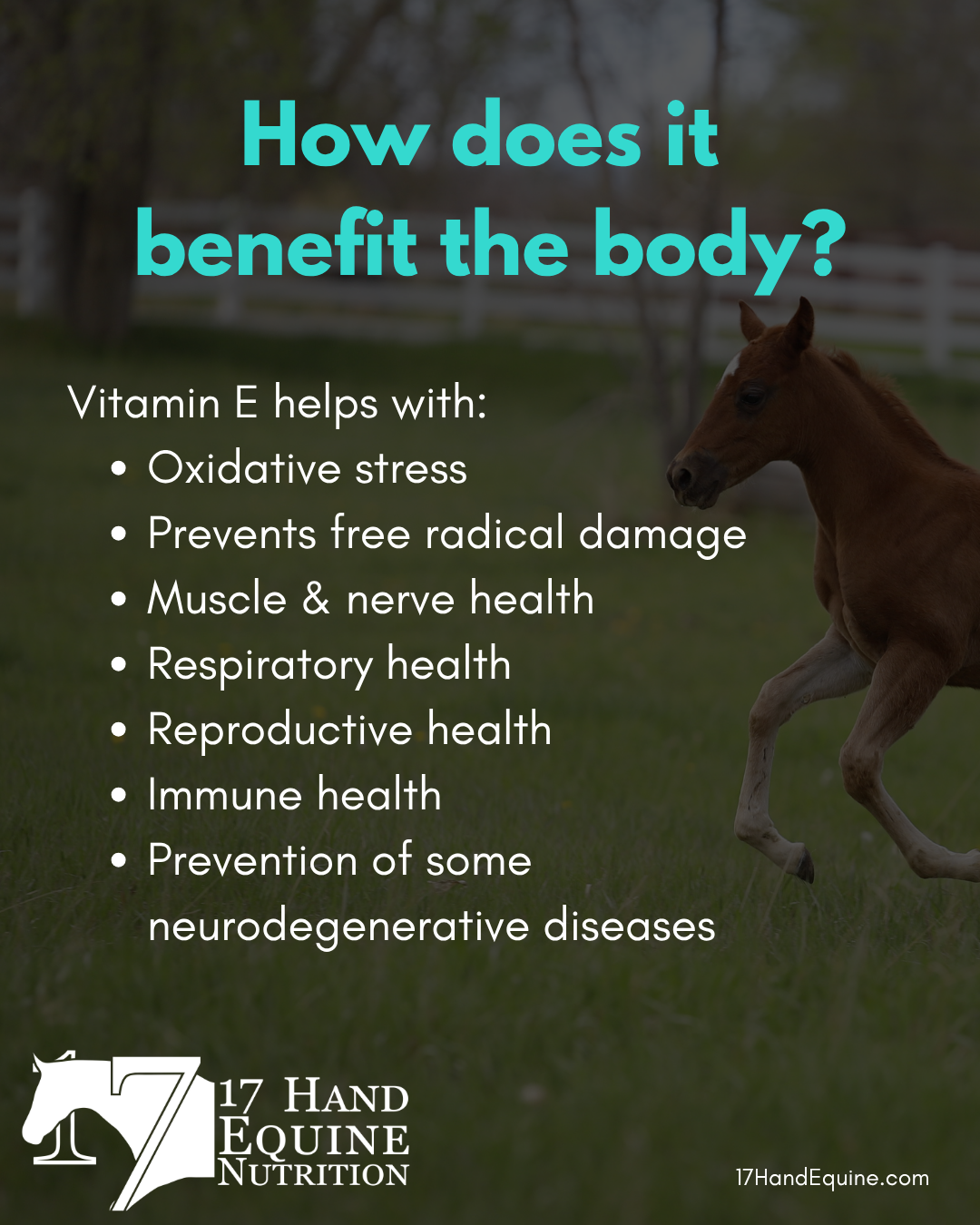
Vitamin E functions as an antioxidant and is important for neuromuscular health. It is an essential fat-soluble vitamin, which means horses cannot make it themselves and require intake of the vitamin in their diet.
What is Natural Vitamin E?
Natural vitamin E, Alpha-tocopherol, specifically the RRR stereoisomer RRR-a-tocopherol (RRR-a-TOH), is the most bioavailable form of vitamin E. Supplements with this form (d-a-tocopherol) come in a water dispersible liquid form which has the highest potency, or in an esterified form (a-TOH acetate) to prolong shelf life. Natural vitamin E (RRR-a-TOH) is very unstable and can easily be damaged by heat or exposure to oxygen. If increasing a horse’s blood serum levels is needed, the liquid form is preferred.
Natural Vitamin E in supplements = d-a-tocopherol
What is Synthetic Vitamin E?
Synthetic vitamin E is a mixture of eight isomers (all-rac-a-tocopherol or dl-a-tocopheryl) and is less bioavailable. Synthetic vitamin E is more stable and less susceptible to heat and oxidative damage, making it the preferred choice for products or feeds that may be handled frequently or exposed to various conditions. However, it does not effectively increase blood serum levels.
Synthetic Vitamin E in supplements = dl-a-tocopherol
Look for the “L”! May also just state “vitamin e”
Where can we find it in the diet?
Vitamin E (RRR-a-TOH) naturally occurs in fresh forage, such as pasture grass. In fact, one of the best measures for broodmares and young horses is turnout on green pasture for at least six months of the year. Once grass is cut, the viability of vitamin E in the forage rapidly declines.
Vitamin E is also found in some vegetable oils and fortified feeds, although the isomer (form of vitamin E indicating bioavailability) may differ.
What are the average requirements?
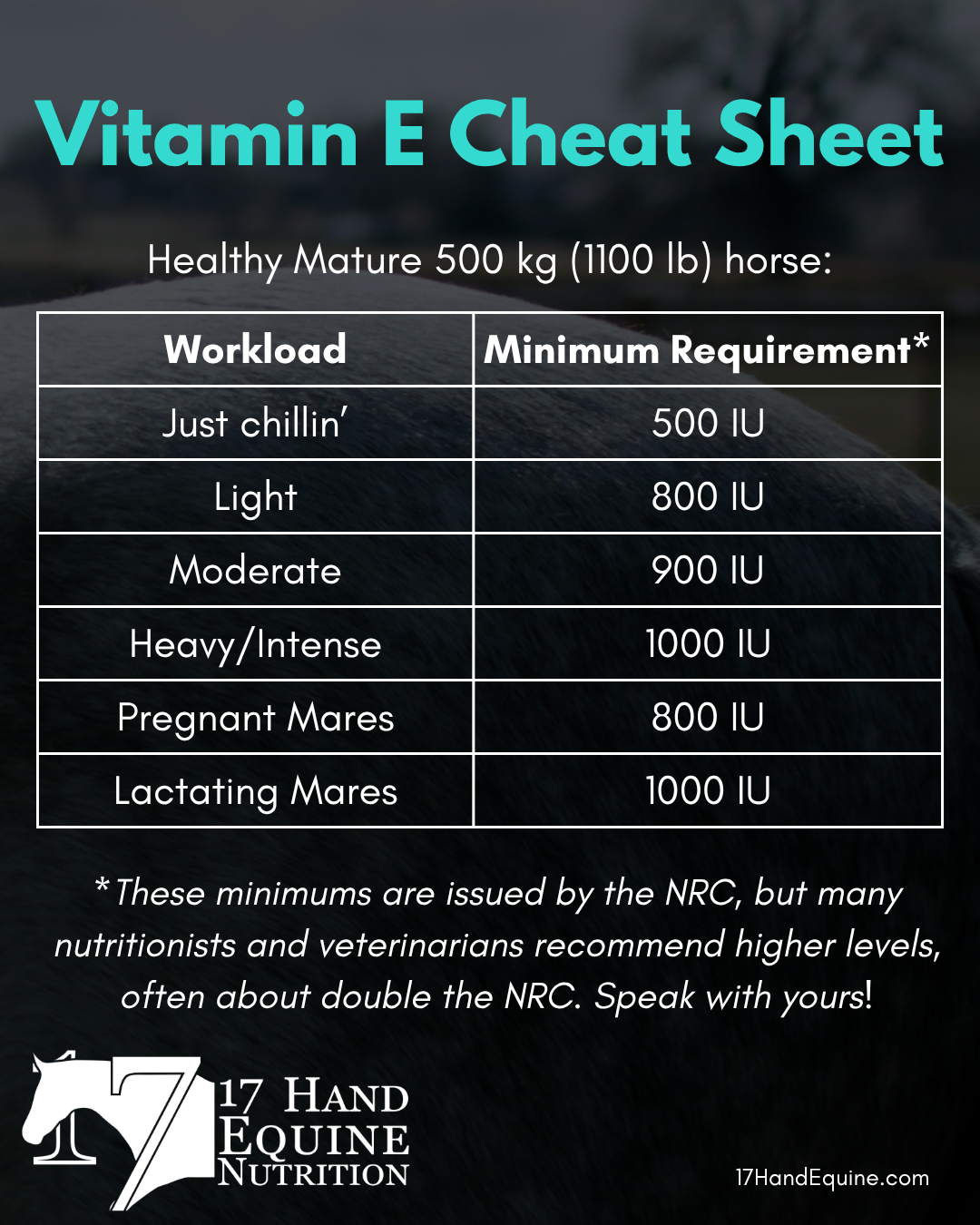
The NRC recommends a minimum of 1-2IU/kg bodyweight. For the average 500kg (1100lb) horse at maintenance, this is 500 - 1000 IU per day. Need increases with workload.
The upper safe limit of vitamin E is 20 IU/kg bodyweight (10,000 IU for a 500kg horse) based on synthetic vitamin E. Excessive vitamin E can lead to impaired bone mineralization and coagulopathy.
Vitamin E & Fatty Acids
It’s a myth that you must feed vitamin E and a fat source together. The fat present in the total of your horse’s diet should already be sufficient for uptake of fat-soluble vitamins.
In diets high in fat, additional vitamin E may be suggested. Fatty acids are prone to oxidation, so increasing the vitamin E in fat-enriched diets may be beneficial.
Don’t guess- Test!
As each horse metabolizes vitamin E differently, testing your horse’s unique blood serum vitamin E status is ideal for accurate supplementation.
Test results (using HPLC lab testing)
Deficient: <1.5 μg/mL (<150 μg/dL)
Marginal: 1.5-2 μg/mL (150-200 μg/dL)
Adequate: >2 μg/mL (>200 μg/dL)
Usually we aim for levels between 3-6 μg/mL, based upon HPLC results.
Help- My horse is deficient!
You must work with your veterinarian on dosage as they will take into consideration multiple factors, including if your horse also has neuromuscular disease. Typically a water dispersible (liquid) form of a-TOH will be recommended, and follow-up checks scheduled to see if your horse responds to the supplement.
If your horse does not respond to a sufficient dose, your vet may explore reasons for malabsorption such as parasitic infection or some type of gastrointestinal inflammation.
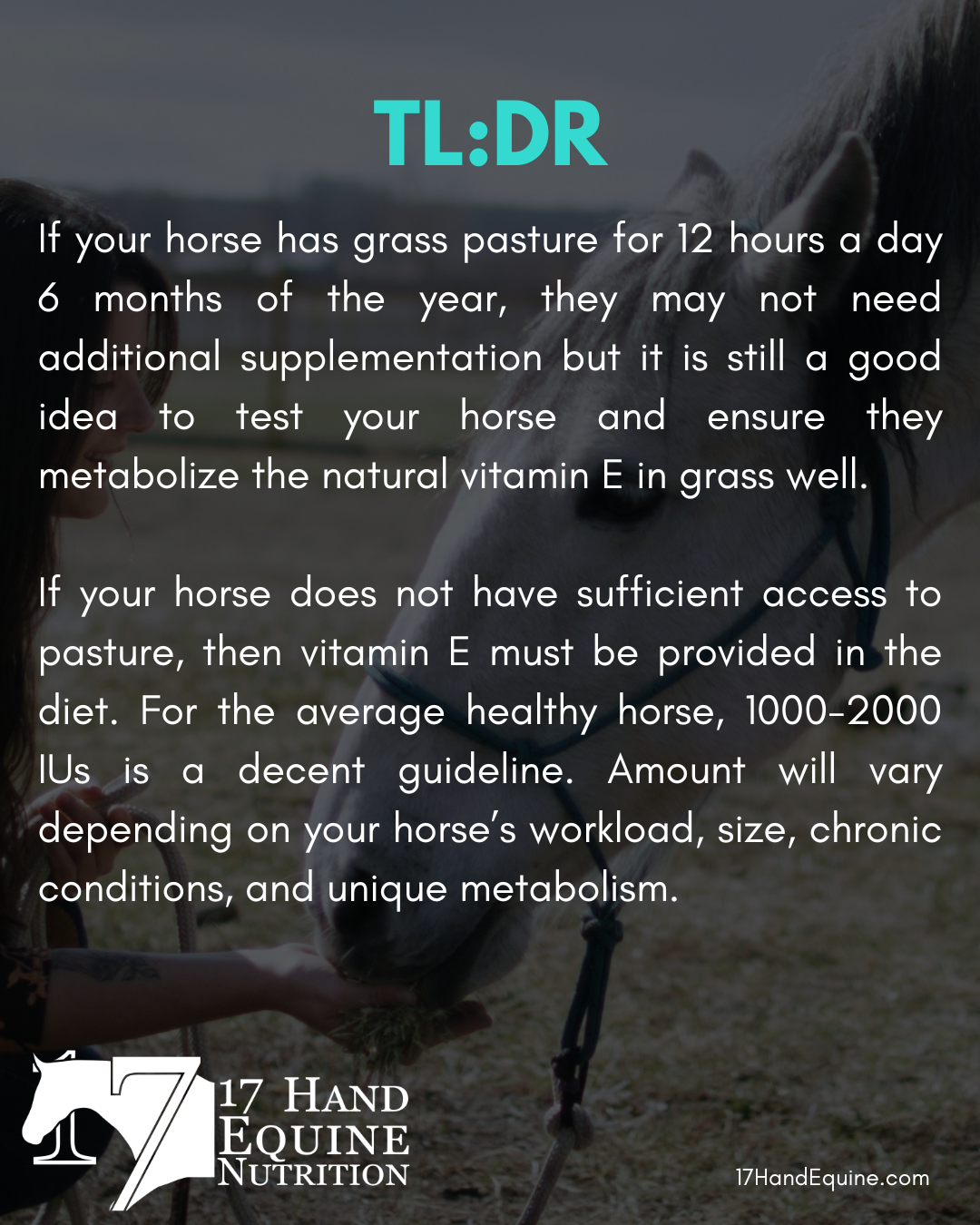
In short, vitamin E supplementation and dosage should ideally be paired with test results. However, that can be cost prohibitive to some people so we do the best we can to cater recommendations based on a multi-factorial approach.
Don’t waste your money on synthetic vitamin E supplements. While horses still get some benefit from synthetic, it does not effectively increase blood serum levels. You have to feed much more of it to reach the levels of absorption of natural vitamin E, so put your money into a supplement with “d-a-tocopherol” from a reputable brand.
Feeding the liquid? Don’t let it oxidize! Feed as soon as possible or place the dose in a syringe out of light to be administered right before meal time.
References
Add vitamin E to high-fat horse diets. Kentucky Equine Research. (2019). https://ker.com/equinews/add-vitamin-e-high-fat-horse-diets/
Finno, C., & Valberg, S. (2018). How to Effectively Supplement Horses with Vitamin E. AAEP Proceedings, 64.
Is it necessary to feed additional fat or oil to my horse when I supplement with a natural vitamin E powder? - KPP. Kentucky Performance Products. (2017, August 4). https://kppusa.com/necessary-feed-additional-fat-oil-horse-when-supplement-natural-vitamin-powder/
The National Academies Press. (2007). Vitamins. In Nutrient Requirements of Horses (Sixth Revised, pp. 114–117). essay.
Zeyner, A., & Patricia, H. A. (2013). Vitamins. In Equine Applied and Clinical Nutrition (pp. 177–180). essay, Saunders Elsevier.