Let’s Get SALTY
What’s in salt?
Salt is made up of two important electrolytes: Sodium and Chloride.
Sodium (Na) is essential for nervous system function, acid-base balance, transport of substances across membranes such as glucose, and osmotic regulation of body fluids.
Chloride (Cl) is an essential component in bile and important for the formation of gastric secretions, and is also a key player in acid-base balance and osmotic regulation.
Your horse’s body NEEDS these to function properly!
Why provide salt?
Salt (NaCl) is often lacking in forage and feedstuffs. Horses will seek it out from dirt, urine, or sweat-covered objects.
Horses sweat out sodium and chloride, meaning replenishment is important. Dehydration from a lack of electrolytes is a risk without supplementation.
Salt helps trigger the thirst response, resulting in greater water intake. Continue providing salt in the winter!
How to give salt:
Free-choice access to a salt block or loose salt can be helpful, but studies find many horses who exercise simply won’t meet their daily requirement via this method. Also, some horses won’t use them.
Providing salt in meals is a great way to ensure your horse is consuming their requirement based on their workload. The average 1000 lb horse needs 30g of salt per day, which is around 2 tablespoons.
Providing a commercial electrolyte on top of daily salt or instead of daily salt can be beneficial for heavy sweaters or high-performing horses.
What to look for:
If you want to provide salt, you can provide whichever form of salt you like best. Plain old table salt is fine. Iodized is fine. Non-iodized is fine. Pink salt is fine. Fancy mineral salt is fine. Whatever form of salt your horse will consume!
If you want to provide an electrolyte, make sure the first ingredient is salt (aka Sodium Chloride). Potassium is also an important electrolyte, which can benefit heavy workers. Avoid electrolytes with sugar or dextrose in them.
Gradually introduce salt to your horse’s meals, as many horses will have a tolerance level. I recommend starting with 1/2-1 teaspoon per meal and increasing over a week.
Electrolytes
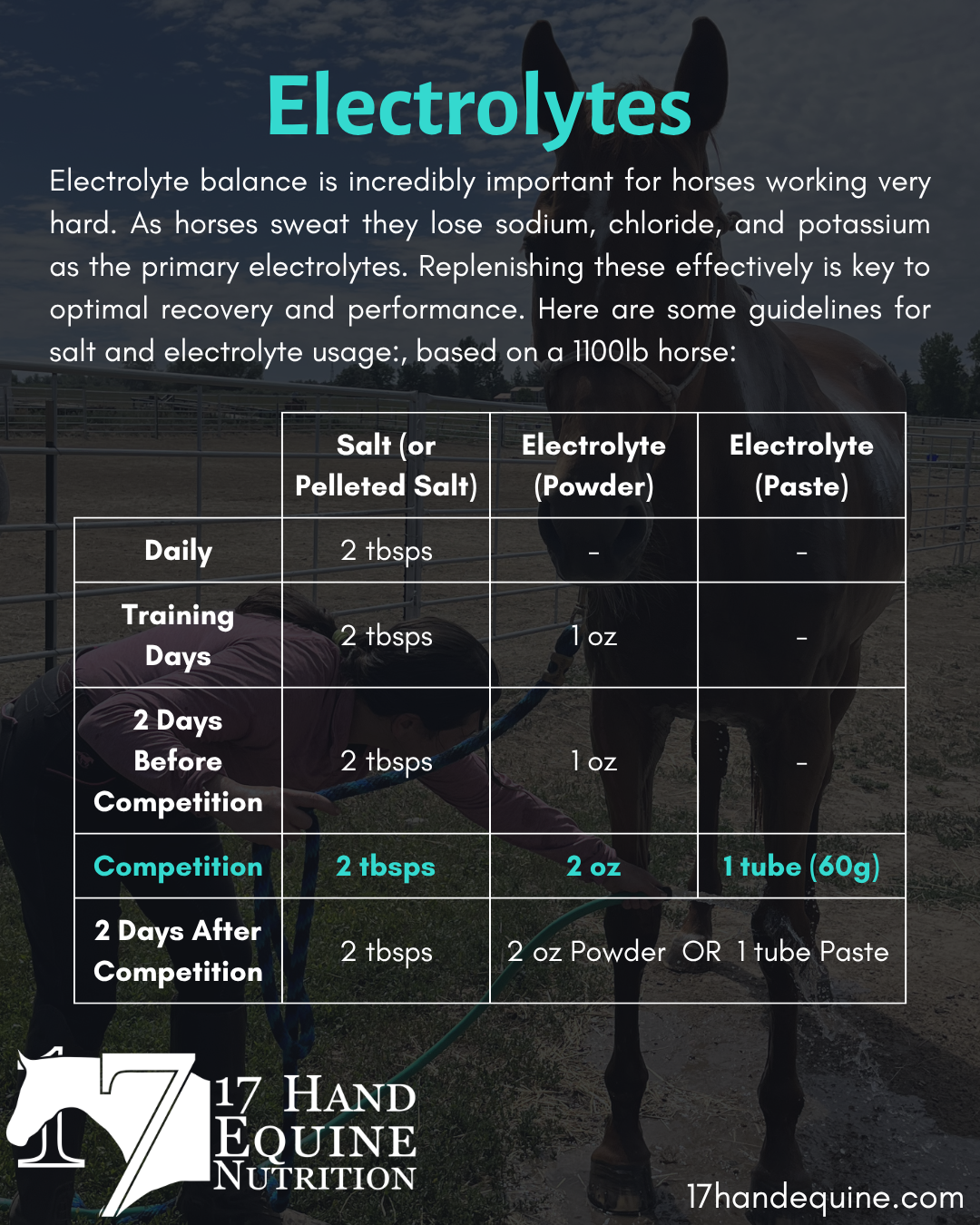
Electrolyte balance is incredibly important for horses working very hard. As horses sweat they lose sodium, chloride, and potassium as the primary electrolytes. Replenishing these effectively is key to optimal recovery and performance. Here are some guidelines for salt and electrolyte usage:, based on a 1100lb horse:
Resources
Geor, Raymond J, et al. Equine Applied and Clinical Nutrition : Health, Welfare and Performance. Oxford, Saunders, 2013.
National Research Council Committee On Nutrient Requirements Of Horses. Nutrient Requirements of Horses. 6th ed., Washington, Dc National Academies Press, 2007.